
1. Are Workers Being Given The Tools To Recover Properly?
Most operations can point to rostered break periods and minimum hours between shifts. Far fewer can confidently say workers are achieving quality recovery during that time.
Recovery is influenced by far more than roster design alone. Sleep environment, circadian disruption, stress, screen exposure, nutrition, alcohol use, and lifestyle habits all affect how effectively workers recover between shifts.
This becomes particularly important during night shift rotations, where workers are attempting to sleep against their biological clock. Research shows night shift workers experience short sleep durations at almost twice the rate of day shift workers, even when sufficient time off is technically available (1).
A worker may have ten hours between shifts, but if recovery is fragmented or ineffective, fatigue can accumulate rapidly across a swing.
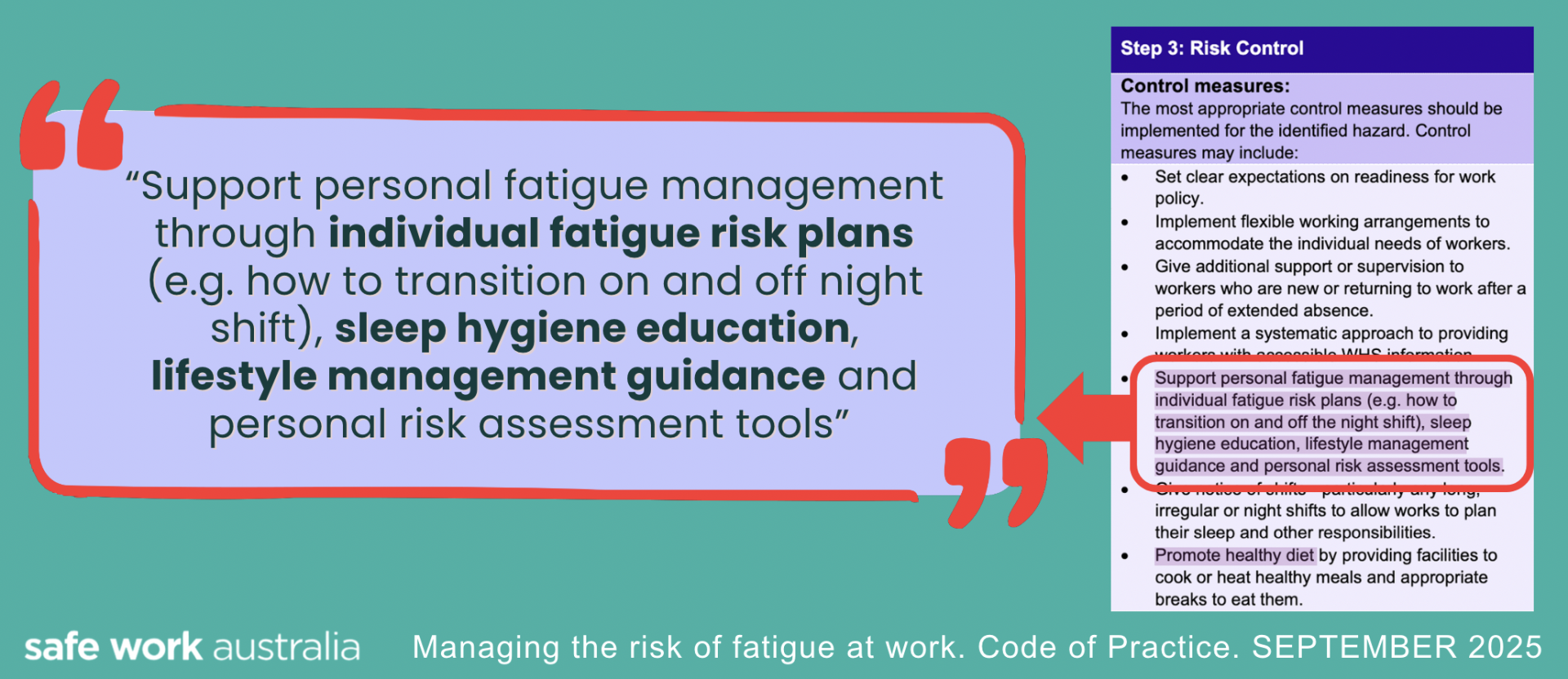
This is why the new approach to fatigue management places greater emphasis on practical education and personal, bottom-up fatigue management strategies, not simply compliance with roster limits.
Workers need support understanding:
Recovery is influenced by far more than roster design alone. Sleep environment, circadian disruption, stress, screen exposure, nutrition, alcohol use, and lifestyle habits all affect how effectively workers recover between shifts.
This becomes particularly important during night shift rotations, where workers are attempting to sleep against their biological clock. Research shows night shift workers experience short sleep durations at almost twice the rate of day shift workers, even when sufficient time off is technically available (1).
A worker may have ten hours between shifts, but if recovery is fragmented or ineffective, fatigue can accumulate rapidly across a swing.
This is why the new approach to fatigue management places greater emphasis on practical education and personal, bottom-up fatigue management strategies, not simply compliance with roster limits.
Workers need support understanding:
The sites leading this space are focusing less on passive awareness training and more on helping workers apply recovery strategies in real operational environments; both on and off shift.
2. Are We Treating Fatigue As An Operational Risk Or An Administrative Process?
Fatigue is often managed through policies, declarations, and procedural controls. While those systems remain important, they are no longer enough on their own.
Fatigue directly impacts cognitive performance:
Fatigue directly impacts cognitive performance:
Importantly, these impairments can develop gradually and may not always be obvious to the worker experiencing them.
Research shows that impacts of prolonged wakefulness on performance, cognitive-decline and safety are comparable to having a blood alcohol level of 0.05% (7).
Yet in many workplaces, fatigue management still centres around maximum shift lengths, tick-box training, self-reporting, sign-on declarations, etc.
The updated fatigue guidance signals a broader expectation. Organisations are increasingly expected to demonstrate proactive risk management through education, recovery support, and practical controls that help workers manage fatigue before incidents occur. That means moving beyond simply documenting fatigue risk and instead creating systems and providing education that actively reduce it (8).
Research shows that impacts of prolonged wakefulness on performance, cognitive-decline and safety are comparable to having a blood alcohol level of 0.05% (7).
Yet in many workplaces, fatigue management still centres around maximum shift lengths, tick-box training, self-reporting, sign-on declarations, etc.
The updated fatigue guidance signals a broader expectation. Organisations are increasingly expected to demonstrate proactive risk management through education, recovery support, and practical controls that help workers manage fatigue before incidents occur. That means moving beyond simply documenting fatigue risk and instead creating systems and providing education that actively reduce it (8).
3. Are Supervisors Equipped To Recognise Cognitive Fatigue?
One of the biggest challenges with fatigue is that it does not always present as obvious physical exhaustion. Cognitive, social, emotional, and psychological fatigue can be just as damaging to both worker wellbeing and operational performance.
Workers themselves are often unreliable at identifying their own impairment, particularly when fatigue develops progressively over several shifts. This places significant responsibility on frontline leaders.
Modern fatigue education needs to help leaders understand:
Workers themselves are often unreliable at identifying their own impairment, particularly when fatigue develops progressively over several shifts. This places significant responsibility on frontline leaders.
Modern fatigue education needs to help leaders understand:
Fatigue incidents rarely occur because of a single failure. More often, they emerge through a series of small performance degradations that go unnoticed until a serious event occurs.
Building leadership capability around fatigue recognition is becoming increasingly important for both safety outcomes and regulatory expectations.
Building leadership capability around fatigue recognition is becoming increasingly important for both safety outcomes and regulatory expectations.
4. Are Psychosocial Factors Increasing Fatigue Risk Onsite?
Fatigue does not occur in isolation. Sleep and recovery are heavily influenced by psychosocial conditions both onsite and at home.
Stress, workload pressure, poor team culture, interpersonal conflict, isolation, and mental strain can all reduce recovery quality and increase fatigue exposure.
Research has found psychosocial factors including stress, low trust in management, reduced decision-making autonomy, work-family conflict, and poorer self-rated health explained 35.9% of chronic fatigue risk among workers, highlighting the significant influence psychosocial factors and workplace culture have on fatigue outcomes.
This is particularly relevant in FIFO and remote environments, where workers may already be managing disrupted routines, social disconnection, and extended time away from support systems.
Importantly, the relationship between fatigue and psychosocial health works both ways: Poor sleep increases psychological strain ⇄ Psychological strain reduces sleep quality
This overlap is one reason fatigue management and psychosocial risk management are becoming increasingly interconnected under modern WHS frameworks.
Organisations relying solely on reactive support systems may miss the broader organisational factors contributing to chronic fatigue exposure, and are now deemed to not be meeting their legislative requirements (8).
Preventative approaches that focus on education, recovery strategies, behavioural awareness, and early intervention are becoming increasingly important in creating sustainable workforces.
Stress, workload pressure, poor team culture, interpersonal conflict, isolation, and mental strain can all reduce recovery quality and increase fatigue exposure.
Research has found psychosocial factors including stress, low trust in management, reduced decision-making autonomy, work-family conflict, and poorer self-rated health explained 35.9% of chronic fatigue risk among workers, highlighting the significant influence psychosocial factors and workplace culture have on fatigue outcomes.
This is particularly relevant in FIFO and remote environments, where workers may already be managing disrupted routines, social disconnection, and extended time away from support systems.
Importantly, the relationship between fatigue and psychosocial health works both ways: Poor sleep increases psychological strain ⇄ Psychological strain reduces sleep quality
This overlap is one reason fatigue management and psychosocial risk management are becoming increasingly interconnected under modern WHS frameworks.
Organisations relying solely on reactive support systems may miss the broader organisational factors contributing to chronic fatigue exposure, and are now deemed to not be meeting their legislative requirements (8).
Preventative approaches that focus on education, recovery strategies, behavioural awareness, and early intervention are becoming increasingly important in creating sustainable workforces.
5. Are We Building A Culture That Supports Sustainable Performance?
Mining has traditionally rewarded endurance, resilience, and pushing through fatigue. But the industry is increasingly recognising that long-term performance depends on recovery just as much as output.
That cultural shift matters.
Workers are more aware than ever of health, wellbeing, and work-life sustainability. At the same time, regulators are placing greater focus on proactive fatigue controls, psychosocial risk management, and preventative safety systems.
The organisations leading this space are embedding fatigue management into:
That cultural shift matters.
Workers are more aware than ever of health, wellbeing, and work-life sustainability. At the same time, regulators are placing greater focus on proactive fatigue controls, psychosocial risk management, and preventative safety systems.
The organisations leading this space are embedding fatigue management into:
Importantly, they are recognising that fatigue management is not simply about responding when workers become impaired. It is about helping workers maintain sustainable performance before fatigue becomes a critical risk.
Because ultimately, fatigue is not a personal weakness. It is a predictable workplace hazard that requires practical, system-level controls and proactive education.
And the mining organisations that take that approach early will be better positioned for safer operations, stronger workforce sustainability, and long-term compliance outcomes.
Because ultimately, fatigue is not a personal weakness. It is a predictable workplace hazard that requires practical, system-level controls and proactive education.
And the mining organisations that take that approach early will be better positioned for safer operations, stronger workforce sustainability, and long-term compliance outcomes.
Click below for more information on proactive fatigue, psychosocial risk, recovery, body clock & human performance strategies in high-risk industries
REFERENCES:
1. Boersma, G. J., Mijnster, T., Vantyghem, P., Kerkhof, G. A., & Lancel, M. (2023). Shift work is associated with extensively disordered sleep, especially when working nights. Frontiers in Psychiatry, 14, 1233640. https://doi.org/10.3389/fpsyt.2023.1233640
2. Kazemi, R. et al. (2016). Effects of shift work on cognitive performance, sleep quality, and sleepiness among petrochemical control room operators. Journal of Circadian Rhythms, 14(1), 1. https://doi.org/10.5334/jcr.135
3. Harrison, Y., & Horne, J. A. (2000). The impact of sleep deprivation on decision making: A review. Journal of Experimental Psychology: Applied, 6(3), 236-249. https://doi.org/10.1037/1076-898X.6.3.236
4. Lim, J., & Dinges, D. F. (2010). A meta-analysis of the impact of short-term sleep deprivation on cognitive variables. Psychological Bulletin, 136(3), 375-389. https://doi.org/10.1037/a0018883
5. Killgore, W. D. S. (2010). Effects of sleep deprivation on cognition. Progress in Brain Research, 185, 105-129. https://doi.org/10.1016/B978-0-444-53702-7.00007-5
6. Yoo, S. S., Gujar, N., Hu, P., Jolesz, F. A., & Walker, M. P. (2007). The human emotional brain without sleep: A prefrontal amygdala disconnect. Current Biology, 17(20), R877-R878. https://doi.org/10.1016/j.cub.2007.08.007
7. Dawson, D., & Reid, K. (1997). Fatigue, alcohol and performance impairment. Nature, 388(6639), 235. https://doi.org/10.1038/40775
8. Safe Work Australia. (2025). Model Code of Practice: Managing the risk of fatigue at work. Australian Government. https://www.safeworkaustralia.gov.au/sites/default/files/2025-09/modelcop_fatigue_sept2025.pdf
1. Boersma, G. J., Mijnster, T., Vantyghem, P., Kerkhof, G. A., & Lancel, M. (2023). Shift work is associated with extensively disordered sleep, especially when working nights. Frontiers in Psychiatry, 14, 1233640. https://doi.org/10.3389/fpsyt.2023.1233640
2. Kazemi, R. et al. (2016). Effects of shift work on cognitive performance, sleep quality, and sleepiness among petrochemical control room operators. Journal of Circadian Rhythms, 14(1), 1. https://doi.org/10.5334/jcr.135
3. Harrison, Y., & Horne, J. A. (2000). The impact of sleep deprivation on decision making: A review. Journal of Experimental Psychology: Applied, 6(3), 236-249. https://doi.org/10.1037/1076-898X.6.3.236
4. Lim, J., & Dinges, D. F. (2010). A meta-analysis of the impact of short-term sleep deprivation on cognitive variables. Psychological Bulletin, 136(3), 375-389. https://doi.org/10.1037/a0018883
5. Killgore, W. D. S. (2010). Effects of sleep deprivation on cognition. Progress in Brain Research, 185, 105-129. https://doi.org/10.1016/B978-0-444-53702-7.00007-5
6. Yoo, S. S., Gujar, N., Hu, P., Jolesz, F. A., & Walker, M. P. (2007). The human emotional brain without sleep: A prefrontal amygdala disconnect. Current Biology, 17(20), R877-R878. https://doi.org/10.1016/j.cub.2007.08.007
7. Dawson, D., & Reid, K. (1997). Fatigue, alcohol and performance impairment. Nature, 388(6639), 235. https://doi.org/10.1038/40775
8. Safe Work Australia. (2025). Model Code of Practice: Managing the risk of fatigue at work. Australian Government. https://www.safeworkaustralia.gov.au/sites/default/files/2025-09/modelcop_fatigue_sept2025.pdf
Created with